Linux Purification Plan - Direct Boot tools for VirtualBox
So first, I need to set up handy environment. QEMU can directly boot kernel and in-memory filesystem, but I hate QEMU because it’s too messy. My another Debian laptop got completely messed up by QEMU, when I uninstalled it, it didn’t disable kernel modules, which made VirtualBox unable to start. Many people in open-source world are unable to do things right, they only love pretentious.
I also hate initrd/initramdisk. Why can’t those amateurs just walk straight? Why do they insist on taking detours, adding extra steps to show off their so-called technical skills? Linux kernel is already bloated enough, does it really matter how much space few filesystem drivers take?
I like VirtualBox's small, stable, cross-platform. I want it to work like QEMU’s direct boot. After many research, feasible approach is: find simplest FAT16 filesystem which kernel can recognize (there’s also ROMFS, but not sure if it can write to hard disk partition). Then write kernel, init and bootcode into .raw format file, and convert to .vdi using VirtualBox tools.
There’s no existing FAT16 creation tool, so I wrote my own raw.c, super floppy format, only one partition, no master boot record. Since FAT has bootstrap section, it can boot properly. Write files sequentially into root directory on consecutive sectors, filenames strictly follow 8.3 convention, and are converted to uppercase. First file will be treated as kernel, loaded by bootcode. Bootcode boot.s is modified from famous https://sebastian-plotz.blogspot.com/ (included in kernel docs), compiled with nasm, then converted to text format with bin2c.c to include in raw.c. I wrote batch file make.bat to include above steps and generate raw.exe.
Next, compile kernel. On my Debian VM, first make allnoconfig or make tinyconfig to get minimal setup, then add support for tty/vt, msdos vfat, elf, etc. (I provided .config from 4.19.325 kernel. Why this version? Because I hate C++; I asked ChatGPT check latest GCC version that can be bootstrapped with pure C, which is 4.7.4, so I chose corresponding kernel version for later researches.)
Then, write simple init.c and compile it statically with gcc -static -o init init.c. Simplest is shown below, but I added some commands to make it looks like MS-DOS.
#include <unistd.h>
int main() {
    const char greetings[] = "Hello";
    write(STDOUT_FILENO, greetings, sizeof greetings);
    for(;;) pause();
    return 0;
}
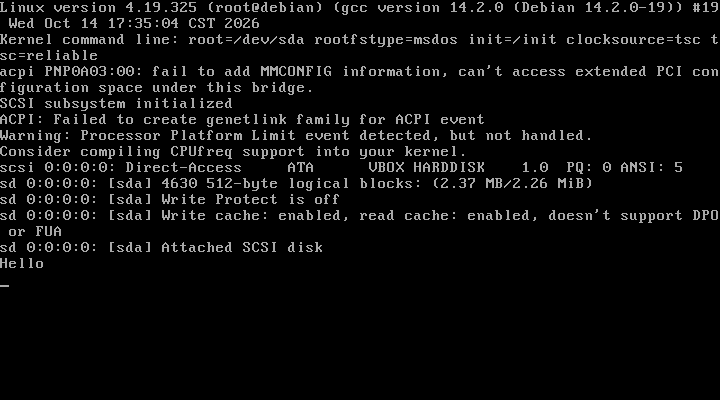
With all materials ready, run raw -o output.raw bzImage init to generate image file, then run VBoxManage convertfromraw output.raw fat16.vdi --format VDI to convert, add it to 64-bit Linux VM, choose SATA/AHCI controller, boot, success. Steps above can be automated by start.js (based on https://github.com/shajunxing/sjx-script).
Comments
Join the discussionNo comments yet. Be the first to comment.